 |
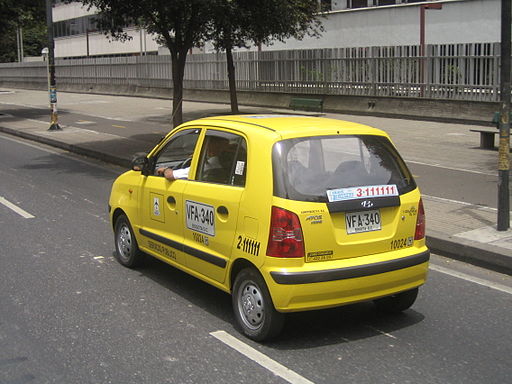
| Bogota taxi |
The creator of the website www.ihatetaxis.com says that Bogota deserves being labelled, by tourists, as the most dangerous city to take a taxi. The businessman Uldarico Rock responds that the most honest cabdrivers are Colombians, especially in the capital. Plus tips for how not to be swindled.
While Bangkok and Cairo are perceived by tourists as the cities where one is most exposed to swindling by cabdrivers, Bogota is seen as the most dangerous place to flag a taxi on the street. At least that's what
www.ihatetaxis.com reports, a website that reports on local transportation in different cities around world, based on experiences shared by travellers.
Todd Romaine, one of the Canadian brothers that created the site in 2008 after being swindled by a cabdriver in Bangkok, says that there can be more dangerous places than Bogota to take a taxi, like Afghanistan, Tajikistán or Somalia, but as these places are little visited, there are not many recorded reports on them.
"I would say that, in general, Honduras, Guatemala, Mexico, Peru, Madagascar, South Africa and Colombia compete for being the places on the planet with the greatest frequency of robberies directed at taxi users", he says.
The major danger in taking a taxi in Bogota? Being a victim of the "millionaire walk", says Romaine.
The perception seems to vary a little with local users.
Here's how the "Paseo Millonario" (Millionaire Ride or Express Kidnap) works: Once you are in the taxi, the driver will stop and pick up accomplices (sometimes taking a detour to do so) and together they rob you. But they do not stop there. They will demand that you withdraw cash from your debit card and credit card at ATMs, and they will drive you around until your withdrawal limit is reached.
(source: IHateTaxis)
According to
http://www.denunciealtaxista.com/, a website created by citizens and focused in Bogota, of the 15,777 negative reports, the major percentage correspond to the category ‘taximeter altered’ (26.6%) and, in second place, to ‘illegal collection’ (20.3%). The second category refers to collection of a fare higher than the taximeter rate (common when the user does not know how units are used to calculate fares), application of nonexistent surcharges or stops to pick up additional passengers.
In terms of security risks and the likelihood of being swindled, Bogota taxis are not well regarded in communities of users. But according to Uldarico Rock, head of the greater business of taxis, the talk about the insecurity is a lie: "It is not certain. It is like foreigners sell the story that we are thieves. This is the most beautiful country, the most honest cabdrivers are those of Colombia and especially those of Bogota", he emphasizes.
As for the accusations of
sobrecargos (the picking up of extra passengers) or altered taximeters, Rock explains that in the Centro Automotriz Carrera (Av. Americas #50-15, tel: 4200209) there are 10 people dedicated exclusively to the attention of the Airport Taxi Radio users (aside of the call centre, the organization has another 280 employees). If it is verified that the taximeter is altered, the business reports it to the Office of the secretary of Traffic.
The master of taxis in Bogota also states that all cabdrivers – there are some 25,000 registered yellow cars - complete a customer service course. "But the media never publish the good reports", regrets. "For example, the cabdriver that delivered a box containing 24 million pesos that been left behind in the trunk. The driver sought out the lady and returned the money to her".
On
http://www.denunciealtaxista.com/, there are 14,158 positive reports and a top 10 list of the better cabdrivers.
THE USERS, UNITED, WILL NEVER BE DEFEATED
Due to the fact that taxis are owned by for private enterprises, user complaints should be directed to those organizations. The colonel of Traffic of Bogota, Jhon Jairo Rodriguez, explains that if the person wants to complain about a cabdriver, he or she should phone the contact number posted in each vehicle.
These phone lines are administered by the business that operates the taxi so, to a certain extent, users are at the mercy of the tools that are provided by each taxi company.
In order to detect altered taximeters, the Police of Traffic provides monitoring. If a driver marks more than one unit for each 100 meters travelled, it is because the taximeter is
descalibrado (de-calibrated), resulting in immobilization of the taxi and a fine of some 290,000 pesos.
With aid of the social networks and continuing some basic interactions, is more difficult for passengers to be swindled or to be in danger in a Bogota taxi:
- Request your taxi by telephone. Generally, the "millionaire walks" begin with a person hailing a taxi on the street.
- Applications for smartphones, such as Easy Taxi (@easytaxicol) or Tappsi (@TappsiCo), are another option to order taxis quickly and securely.
- Keep in mind that a unit is marked each 100 meters or 30 seconds.
- On www.denunciealtaxista.com you can check the taxi's plate, to see if there are any negative reports about the driver. On Twitter, tweet #taxiseguro followed by the taxi # in a mention to @denuncietaxista.
- The community offers other useful tools to consult: a map of the places where "millionaire walks" are most reported, a guide to how much a taxi should cost from one place to another in the city, and a copy of the official 2013 rate guide.
- Uldarico Rock says the good stories should be of shared.
- www.ihatetaxis.com recommends to you lock the doors, not to accept shortcuts and, in the case of robbery, not to fight with the cabdriver (they may be armed).
- If already swindled, communicate with the business. Taxexpress (4111111), for example, returns the fare in case of taximeter alteration.
- Don't stop sharing your experience with others. If it is negative, you can save another, and if it is good, sharing can help carry all of us to a better reputation in this chaotic city. On Twitter, you can denounce with: @Denuncietaxista #I Denounce, and congratulate with: @Denuncietaxista #buentaxista.
BY MARIA CAMILA HERNÁNDEZ ALONSO
Follow IHateTaxis on Twitter:
@IHateTaxis
Read the IHateTaxis transportation guide to
Bogota El Nuevo Dorado International Airport (BOG) - or jump directly to the
IHateTaxis Bogota Taxi page.
Read the original version of the story on Portafolio:
La mala fama de los taxis bogotanos ya es internacional
Note that the above is a revised English translation of the original Spanish original.